Leave Your Message

2026 Top Plastic Spoons for Global Buyers Which to Choose?

Choosing the right Plastic Spoons in 2026 requires more than comparing unit prices. Global buyers now examine material safety, product strength, packaging, recycling claims, and supply reliability. A spoon may look simple, yet its resin grade affects stiffness, taste neutrality, and performance in hot desserts or thick sauces.

The OECD reported that global plastic waste reached 353 million tonnes in 2019. Only 9% was ultimately recycled. UNEP also warns that plastics can generate significant pollution throughout their lifecycle. These figures make single-use spoon selection a procurement decision, not merely a catering purchase. Sander Defruyt, a plastics circularity expert at the Ellen MacArthur Foundation, stated, “We cannot recycle our way out of the plastic pollution crisis.” His point matters for buyers comparing virgin plastic, recycled-content options, and reusable systems.

Market reports from Smithers and Grand View Research indicate continued demand for foodservice packaging, especially in takeaway, institutional catering, and e-commerce meal delivery. However, forecasts differ by methodology. That uncertainty deserves attention. A projected growth rate is not a guarantee for every region, supplier, or spoon format.

This guide compares leading Plastic Spoons by durability, finish, packaging efficiency, customization, and documented compliance information. It also considers practical details, such as whether a spoon bends beside a hot pudding or arrives with cracked handles after ocean transport. No option is perfect. Lower cost can mean weaker performance, while heavier designs may increase material use. Buyers should check current test reports, supplier audits, and destination-market requirements before placing large orders.
2026 Top Plastic Spoons for Global Buyers Which to Choose?

Plastic Spoon Types and Their Main Applications in 2026

2026 Top Plastic Spoons for Global Buyers: Which to Choose?

Plastic spoons now serve different food settings, not just casual takeaway meals. Standard polypropylene spoons suit soups, desserts, rice dishes, and everyday catering. They offer useful toughness and moderate heat resistance.

Polystyrene spoons feel rigid and economical, but they may become brittle in colder conditions. Buyers should check local food-contact requirements before selecting either material.

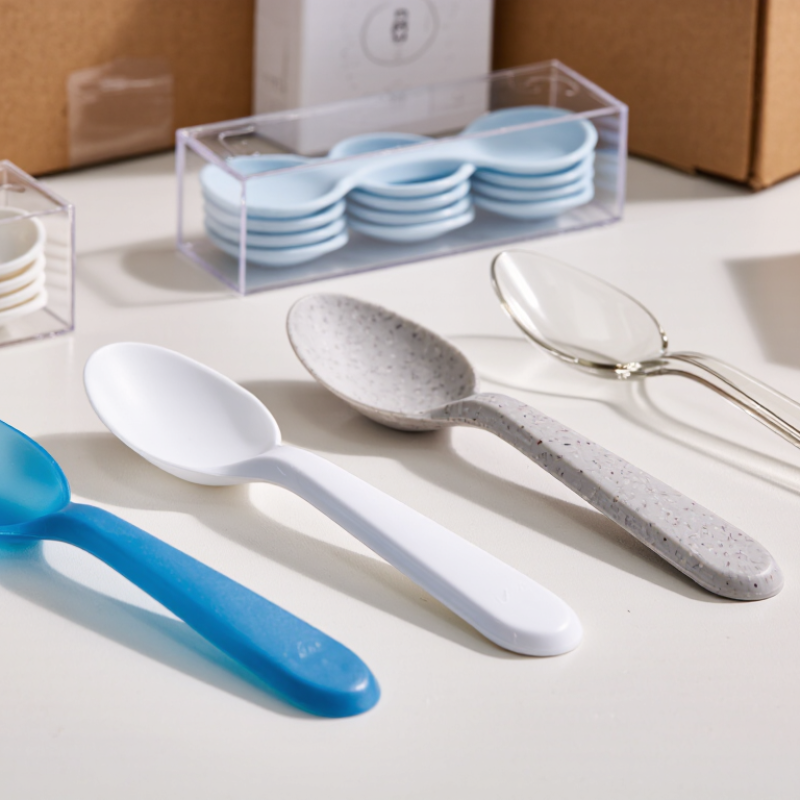
Heavy-duty spoons have thicker handles and deeper bowls. They work well with thick yogurt, frozen desserts, porridge, and institutional meal services. Small tasting spoons fit sauces, samples, and event counters.

Clear spoons improve product visibility, while colored spoons support portion identification. For compostable-service goals, plant-based options may help, but buyers must confirm certified disposal facilities first.

In practical sourcing checks, spoon performance depends on more than material. Inspect the handle for sharp edges, the bowl for clean molding, and cartons for moisture damage. Test samples with hot soup and oily food.

Some spoons advertised as “premium” still bend under real use. That is easy to overlook.

Packaging also matters in 2026, especially for export orders. Nested spoons reduce carton volume, while individually wrapped units support hygiene in hospitals and transport services. A reliable specification should state material, length, bowl size, weight, packing method, and intended application.


Key Material, Safety, and Performance Differences

2026 Top Plastic Spoons for Global Buyers: Which to Choose?

Material decides more than appearance. Polypropylene spoons are light, flexible, and usually perform well with hot soups. Polystyrene spoons feel rigid, but they can become brittle in cold storage. CPLA spoons offer a plant-based image, yet many require commercial composting facilities. That infrastructure is not available in every market. The OECD reported that global plastic waste reached 353 million tonnes in 2019, while only 9% was recycled. This makes disposal planning as important as material selection.

Safety testing should cover food contact, migration, odor, and heat resistance. Buyers should request recent laboratory reports, not only supplier declarations. Relevant checks may include FDA food-contact requirements, EU Regulation 10/2011, and applicable local standards. Performance also needs practical testing. Fill a spoon with hot broth, bend the handle, and inspect the edge after cooling. A small crack can injure users or create complaints. Product claims are sometimes too confident. Real-world testing may reveal weaker results.

Tips: Compare spoons at their actual serving temperature. Confirm resin identification and recycled-content documentation. Ask whether compostable products have certified facilities nearby. Check packaging strength during humid shipping. A cheaper spoon may fail through breakage, odor, or poor stacking. The UNEP 2023 report also identifies packaging as a major driver of plastic pollution, so reducing excess wrapping matters. Selection is rarely perfect. It requires balancing safety, durability, cost, and local waste systems.

2026 Top Plastic Spoons for Global Buyers: Which to Choose?

PP offers a balanced combination of heat resistance, toughness, and cost efficiency for everyday hot and cold foods. PS is generally economical but has lower heat tolerance. PLA is plant-based and suitable for cooler applications, while CPLA provides improved heat performance but may require commercial composting infrastructure. Values shown are representative midpoints for commonly used food-service grades; actual performance depends on formulation, spoon geometry, and certification. Buyers should verify food-contact compliance for the destination market.

How to Compare Plastic Spoon Quality and Design

2026 Top Plastic Spoons for Global Buyers: Which to Choose?

How to Compare Plastic Spoon Quality and Design

Choosing a plastic spoon starts with its intended use, not its appearance. A soup spoon needs a deeper bowl and a stable grip. A dessert spoon can be lighter, but its edge should remain smooth after molding. Check the material declaration, food-contact compliance, and batch traceability before comparing prices. The OECD reported that only 9% of global plastic waste was recycled in 2019. This makes material selection and disposal guidance practical purchasing concerns.

Inspect ten samples from different cartons, not just one piece. Look for flash around the rim, uneven thickness, cloudy spots, and weak handles. Press the bowl gently. It should flex slightly without cracking or leaving a sharp crease. For hot food, request heat-resistance test data under realistic serving conditions. ISO 178 measures flexural properties, but it does not replace application testing. This distinction is often missed.

Design also affects transport and user comfort. A nested spoon should separate cleanly, without sticking or scratching. Handle length must fit the container commonly used by customers. In 2022, global plastics production reached about 400 million tonnes, according to Plastics Europe’s industry data. That scale increases the value of lightweight designs, but thin does not always mean efficient. My checklist still has a blind spot: appearance can influence decisions too strongly. A perfect sample may hide inconsistent production. Ask for pre-shipment inspection records and retain sealed samples for comparison.

Global Buyer Standards, Certifications, and Supplier Checks

2026 Top Plastic Spoons for Global Buyers Which to Choose?

Global buyers should judge plastic spoons beyond price, color, and packing speed. Food-contact compliance must match the destination market. In the European Union, suppliers should provide evidence aligned with Regulation (EU) No 10/2011. For the United States, food-contact status should be checked against applicable federal requirements. Ask for migration test reports, material declarations, and batch traceability. A certificate without a matching product scope proves very little.

Sustainability data also deserves careful review. The OECD’s Global Plastics Outlook reported 353 million tonnes of plastic waste in 2019, with only 9% recycled. Therefore, buyers should request recycled-content evidence, where legally suitable, and verify whether claims apply to the spoon itself. The UNEP report Turning off the Tap estimated that plastic pollution could be reduced by 80% by 2040 through system-wide changes. Yet “eco” wording remains too vague.

Supplier checks should include ISO 22000 or equivalent food-safety systems, audited manufacturing records, and documented quality controls. Request recent third-party reports, not scanned certificates alone. Inspect carton labels, spoon edges, odor, cracking, and dimensional consistency. Samples can pass while mass production drifts. That risk is easy to underestimate. Review corrective-action records, worker hygiene controls, and change-notification procedures. A practical final check is simple: compare the approved sample with three random production cartons before shipment.

2026 Top Plastic Spoons for Global Buyers: Which to Choose? — Global Buyer Standards, Certifications, and Supplier Checks
Buyer Dimension What to Check Relevant Standard, Rule, or Evidence How It Helps You Choose
Destination-market rules Confirm that the spoon’s material, intended use, and product category are permitted in every target market. Check rules for single-use items separately from rules for reusable tableware. Requirements vary by country and may change. For example, the EU Single-Use Plastics Directive restricts certain single-use plastic cutlery, including spoons. Confirm applicable national implementation and product classification before ordering. Do not assume that food-contact compliance alone makes a single-use plastic spoon lawful to sell. Obtain market-specific regulatory review before production.
Food-contact compliance Identify the exact polymer and intended food-contact conditions, including food type, contact time, temperature, and whether use is single-use or repeated. In the EU, relevant framework requirements include Regulation (EC) No 1935/2004 and, for plastic food-contact materials, Regulation (EU) No 10/2011. In the United States, applicable FDA food-contact requirements depend on the substance, conditions of use, and relevant regulations or authorizations. Ask for documentation that matches the exact spoon grade, color, manufacturing site, and intended conditions—not a generic statement that the product is “FDA” or “EU approved.”
Migration testing Request overall and, where applicable, specific migration results using conditions representative of the intended foods and use. Check the laboratory, test date, sample identity, and test method. EU plastic food-contact requirements include overall and specific migration limits, with test conditions selected to represent foreseeable use. Applicable limits and methods depend on the material and use scenario. Match test reports to the final product specification. A report for a different resin, colorant, thickness, or use condition may not substantiate the offered spoon.
Material selection Compare the declared polymer, product design, intended serving temperature, stiffness, and resistance to bending or breakage. Polypropylene (PP) is widely used for food-contact articles, but suitability depends on the specific grade and conditions. Polystyrene (PS) and other materials also require evaluation against destination-market rules and intended use. Choose from verified performance and compliance data, not the material name alone. Request samples and test them with the actual foods and serving conditions.
Temperature and use claims Ask for the supplier’s stated maximum use conditions and clarify whether the spoon is intended for hot foods, microwaving, dishwashing, or repeated use. There is no single temperature limit that applies to every spoon made from a given polymer. The finished article’s material grade, design, and applicable food-contact conditions matter. Require written, product-specific limits and validate them with an appropriate test or use trial. Do not infer microwave or dishwasher suitability from a resin name.
Declarations and traceability Obtain a product-specific declaration of compliance where required, technical specification, bill-of-material or material statement, and batch identification system. EU plastic food-contact supply chains have documentation requirements under Regulation (EU) No 10/2011; good manufacturing practice is addressed by Regulation (EC) No 2023/2006. Check that documents identify the legal supplier, product or SKU, material, intended use, limitations, and revision date. Confirm that production lots can be traced to records and test results.
Quality-management systems Review the factory’s quality procedures, incoming-material controls, production inspections, complaint handling, and corrective-action records. ISO 9001 is a quality-management-system standard. It is not, by itself, a food-contact approval or proof that a particular spoon complies with local law. Verify the certificate’s scope, issuing body, validity, and covered site. Use it as one supplier-quality indicator alongside product-specific compliance evidence.
Compostability claims If a spoon is marketed as compostable, identify whether the claim is for industrial composting or home composting and whether it covers the finished product, color, and thickness. EN 13432 is a European standard used to assess packaging recoverable through industrial composting and biodegradation. ASTM D6400 is used for plastics designed for municipal or industrial aerobic composting. Neither claim alone establishes home-compostability or food-contact compliance. Request a valid certificate or test evidence for the exact product and confirm that suitable composting collection and processing are available in the intended market.
Recycled-content claims Ask whether recycled material is used, its source and percentage, and whether its use is permitted for the intended food-contact application in the destination market. Food-contact rules for recycled plastics differ among jurisdictions and processes. General recycled-content documentation does not by itself establish food-contact suitability. Require market-specific regulatory evidence and clear chain-of-custody records before accepting a recycled-content claim for a food-contact spoon.
Supplier verification Verify the manufacturing address, production capability, subcontracting arrangements, audit history, product-change controls, and willingness to provide samples and technical documents. Supplier audits and third-party testing can support due diligence, but neither replaces the buyer’s obligation to check applicable market rules and product documentation. Approve the actual production site and finished-product specification. Put material, dimensions, packaging, change notification, inspection criteria, and corrective actions into the purchase agreement.
Incoming inspection and shipment control Set acceptance criteria for dimensions, weight, appearance, contamination, packaging, count, and functional performance. Define sampling and non-conformance procedures. Use an agreed inspection plan and documented lot or batch identification. Keep retained samples and shipment records where appropriate. Link every shipment to the approved specification and compliance file. Reassess documentation after changes to resin, additives, color, factory, or production process.

Buyer note: Regulatory references are provided as a screening guide, not a complete legal determination. Requirements depend on the destination country, product design, intended use, and current local rules; confirm them before placing an order.

Choosing the Best Plastic Spoon for Cost and Use Case

When buying plastic spoons in 2026, price should not be the only deciding factor. A low unit cost can become expensive when spoons bend, crack, or arrive poorly packed. I have found that a spoon’s weight, bowl depth, and handle strength matter during real service. A thin spoon may suit yogurt samples, but it feels weak with hot soup. Small detail. Big impact.

Match the spoon to the use case. For catering, a medium-weight spoon often balances comfort and shipping cost. For takeaway desserts, a shorter handle can reduce packaging space. For schools or large events, consistent sizing and smooth edges help staff work faster. Clear material specifications are essential. Ask for food-contact documentation, production tolerances, packaging details, and test samples before ordering. These records support safer and more reliable purchasing decisions.

Cost comparisons should include freight, carton volume, breakage, and storage space. A slightly heavier spoon may reduce complaints, yet it can increase transport charges. That trade-off deserves calculation. I once underestimated carton size and paid more for warehouse handling than expected. It was a useful mistake. Buyers should also check whether the spoon remains stable under the intended temperature and food texture. A sample test with pudding, soup, or frozen dessert reveals more than a catalog photograph. Choose practical performance over impressive claims.