Leave Your Message

7 PLA Bowl Buying Tips for Global Buyers

A Pla Bowl can look sturdy in a product photo and still disappoint in a buyer’s hand. A rolled rim, a warm meal, or a damp salad can reveal weaknesses quickly. Global buyers need more than attractive samples. They need to check material claims, bowl dimensions, heat performance, packing, supplier consistency, and the disposal options available to customers.

Bioplastics researcher Dr. Ramani Narayan’s work offers a useful reminder. Paraphrased, his message is: “Judge a material by the system that handles it, not by its label alone.” That distinction matters. PLA products may require specific conditions for composting, and those conditions are not available everywhere. A confident claim on a carton is not enough. Ask for supporting documents, test details, and clear explanations of the product’s intended use.

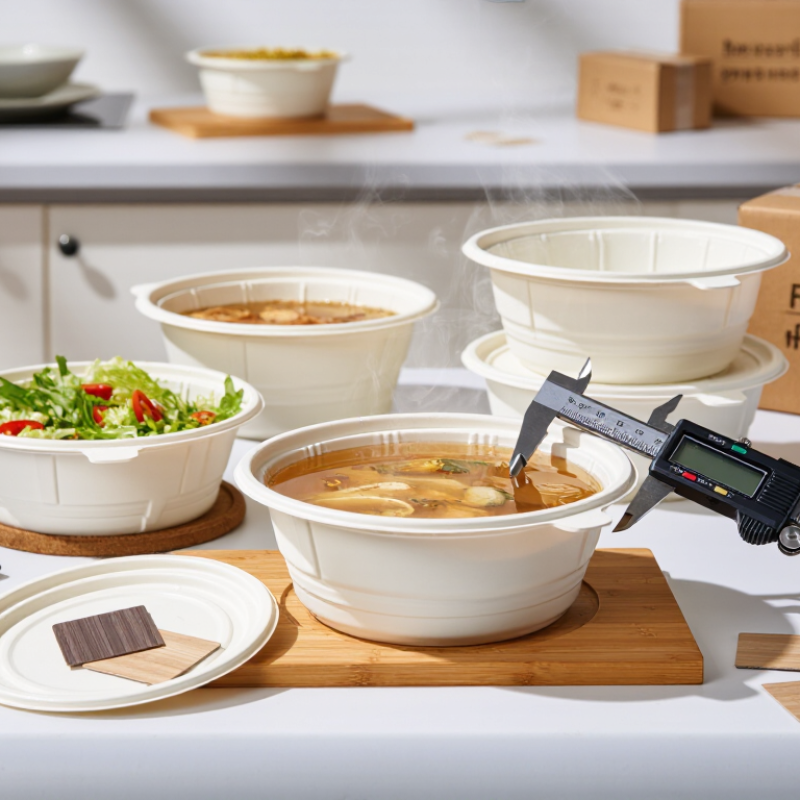
This guide presents seven practical buying tips for global sourcing teams. It looks at specifications, sample testing, certifications, production capacity, packaging, shipping, and supplier communication. Small checks matter. Measure the bowl’s rim and base. Fill it with the food it is meant to hold. Ask what happens when a shipment arrives late or a sample differs from mass production. Even careful buyers can miss something; I would not treat one successful test as proof of every claim. The aim is a more informed purchase, with fewer surprises between the sample, the factory, and the customer.
7 PLA Bowl Buying Tips for Global Buyers

Understanding PLA Bowl Materials and Food-Contact Certifications

PLA bowls are usually made from polylactic acid, a plant-derived plastic. The feedstock sounds reassuring, but it does not prove a bowl is safe for every food or temperature. Ask suppliers for the exact resin composition and the bowl’s stated temperature range. A bowl holding chilled fruit may behave differently from one filled with hot soup. Small detail. Big consequence.

Review documents for the finished bowl, not just its raw material. For U.S. shipments, request evidence supporting applicable FDA food-contact requirements; FDA does not generally “certify” individual bowls. For European markets, ask for relevant food-contact declarations and test reports. Check that the paperwork identifies the product, intended food types, contact conditions, and testing laboratory. If a report covers only a resin pellet, it may not address pigments, additives, or manufacturing changes.

Compostability is a separate question. Standards such as EN 13432 or ASTM D6400 relate to compostability claims, not food-contact safety. Nor do they guarantee that a local facility accepts the bowl. Ask whether the claim applies to the complete article and which disposal conditions are required. I would also verify document dates and product codes; they are easy to overlook when a quotation looks complete. A certificate can still leave a gap. When details conflict, pause the order and request written clarification.

Matching Bowl Size and Performance to Intended Use

7 PLA Bowl Buying Tips for Global Buyers

Matching Bowl Size and Performance to Intended Use

Choose bowl capacity from the actual serving, not a supplier’s nominal ounce label. Test your menu portion in the bowl, leaving headspace for sauces and transport. Check interior diameter too: a wide bowl can fit toppings better, while a deeper shape may reduce splashes. Fit matters. Confirm dimensions against lids, sleeves, and delivery bags before ordering.

Match wall thickness and rim strength to the food’s weight and journey. A thick curry or grain bowl needs more support than a light salad. European Bioplastics’ 2024 market update estimates packaging represented 45% of global bioplastics production capacity, showing why buyers should compare specifications carefully.

For hot service, ask for tested fill-temperature and deformation data. PLA’s glass-transition temperature is commonly reported around 55–65°C, but performance varies with formulation and crystallinity (Lim, Auras and Rubino, Progress in Polymer Science, 2008). Don’t assume every PLA bowl handles hot soup.

Test filled bowls for leaks, softening, and stacking stability over your real delivery time. One detail is easy to miss: lids may fit a rim but still pop loose during transit. Request samples, then test them with your heaviest and hottest menu items.

Evaluating Supplier Quality, Production Capacity, and Customization

When comparing PLA bowl suppliers, request recent food-contact test reports, resin specifications, and batch-level traceability. Check whether documents match the offered bowl’s grade, thickness, and intended use. Ask for proof. A polished sample can hide uneven rims, weak seams, or inconsistent wall thickness. Inspect bowls from several production batches, not only a handpicked sample, and record defects against agreed tolerances.

Capacity is not output. European Bioplastics’ 2024 market data report estimates global bioplastics production capacity at 2.47 million tonnes that year, with packaging representing 45% of capacity. These figures cover bioplastics broadly, not PLA bowls alone. Use them as market context, not as evidence that a supplier can meet your order. Request monthly line capacity, recent utilization, lead-time records, and a production schedule. Ask how the factory manages peak-season orders and resin shortages. Then compare promised volumes with actual shipment records.

For customization, confirm tooling ownership, mold costs, minimum order quantities, and sample approval steps in writing. Specify bowl diameter, brim shape, stack height, color tolerance, and logo placement. A small rim change may affect stacking or lid fit. Request a pilot run before approving full production, and test filled bowls under realistic serving conditions. No checklist catches everything. I would also revisit specifications after the first shipment; buyer assumptions can be wrong, and supplier feedback sometimes exposes details nobody considered.

7 PLA Bowl Buying Tips for Global Buyers — Evaluating Supplier Quality, Production Capacity, and Customization
# Buying Tip What to Evaluate What to Verify Practical Decision Check
1 Confirm the material composition Check whether the bowl is made from PLA, a PLA blend, or another material, and whether coatings, additives, or colorants are included. Request a current material specification and a declaration identifying the materials used in the finished bowl. Make sure the documents describe the exact bowl model and match the product being quoted.
2 Check food-contact compliance for the destination market Requirements vary by country or region and may depend on the product’s intended food type, temperature, and conditions of use. Ask for applicable food-contact test reports or declarations, and confirm the issuing laboratory, test date, and tested product details. Verify compliance against the rules in the country where the bowls will be sold or used; do not rely on a generic claim of “food grade.”
3 Evaluate compostability claims carefully Industrial compostability is different from home compostability and does not mean a product will break down in every environment. For claims based on standards such as ASTM D6400 or EN 13432, check the certificate or test documentation and confirm that its scope covers the exact product. Confirm the required disposal route and local composting availability before using compostability claims in customer-facing materials.
4 Test performance under intended use Assess rim strength, rigidity, leakage, stacking, and performance with the intended foods and serving conditions. PLA products can have heat limitations that vary by formulation and construction. Request test results or samples and check the supplier’s stated temperature and use limits for the specific bowl. Run a trial using realistic food, fill level, holding time, transport, and temperature conditions before approving bulk production.
5 Assess production capacity and process control Review available production lines, normal lead times, quality checks, and the supplier’s ability to maintain consistent dimensions and appearance across batches. Ask for production-capacity details, a process overview, inspection records, and the planned production schedule for your order. Compare the confirmed schedule with your required delivery dates, including time for sampling, production, inspection, and transport.
6 Set measurable quality acceptance criteria Agree on bowl dimensions, capacity, weight, color, rim finish, packaging, and acceptable defect levels before placing an order. Request a signed specification and approved pre-production sample; define how inspections and any corrective actions will be handled. Use the same written criteria for sample approval, in-process checks, and final inspection to reduce interpretation disputes.
7 Clarify customization, tooling, and order terms Confirm available sizes, colors, embossing or printing options, packaging formats, tooling requirements, minimum order quantities, and repeat-order conditions. Request a written quotation showing customization costs, tooling ownership or access terms, setup charges, minimums, and sample or artwork approval steps. Approve a final sample and artwork proof before production, and confirm that any changes to specifications or order quantities are documented in writing.

Comparing Prices, Order Quantities, and Shipping Options

7 PLA Bowl Buying Tips for Global Buyers

Comparing PLA bowl quotes takes more than checking the unit price. Bowl capacity, wall thickness, lid fit, and packing style can all change the cost. Ask suppliers to quote the same specifications and show costs by order quantity. Small details matter. A lower price may reflect thinner bowls or different carton counts, so request a sample and product documents before placing a large order.

Tip: Compare price tiers at several quantities, such as 5,000, 10,000, and 20,000 bowls. Check the minimum order quantity and ask whether mixed sizes are allowed. Smaller orders can reduce storage pressure, but setup fees may raise the unit cost. Not always. A spreadsheet can still miss changes in freight or packaging, so leave room for a revised estimate.

Shipping can alter the final cost significantly. Request quotes for available transport methods and confirm whether they include inland delivery, export packing, and destination charges. For ocean freight, compare the shipment’s volume as well as its weight; cartons of lightweight bowls can take up substantial space. Ask for estimated transit times and production lead time separately. Ask for both. A modest delivery buffer may help, though it is not a guarantee.

Checking Samples and Confirming Purchase Terms

A PLA bowl sample can look convincing on a screen and still feel flimsy in hand. Request samples from the production specification, not a display piece. Check rim smoothness, wall thickness, base stability, and how the bowl holds its shape with the intended serving. Pour in warm food and wait several minutes. Note any softening, odor, or surface change. Results depend on the material grade and use conditions, so record what you tested.

Tips: Photograph each sample beside a ruler. Weigh several bowls, not just one. Ask for the stated capacity and tolerances in writing. If samples differ, pause before approving. A small inconsistency can become a large shipment issue.

Before ordering, confirm the sample reference, quantity, unit price, tooling or setup charges, packaging, delivery schedule, and payment milestones. Specify which sample version the supplier must match, including color and dimensions. Request relevant material and food-contact documentation for your intended market, then verify that the documents identify the supplied product. Keep approved samples and signed specifications together. A sample approval is useful, but it does not guarantee every bowl will be identical. That part is easy to overlook. Clarify how defects, shortages, or late delivery will be handled, and get the agreed process in the purchase order.